
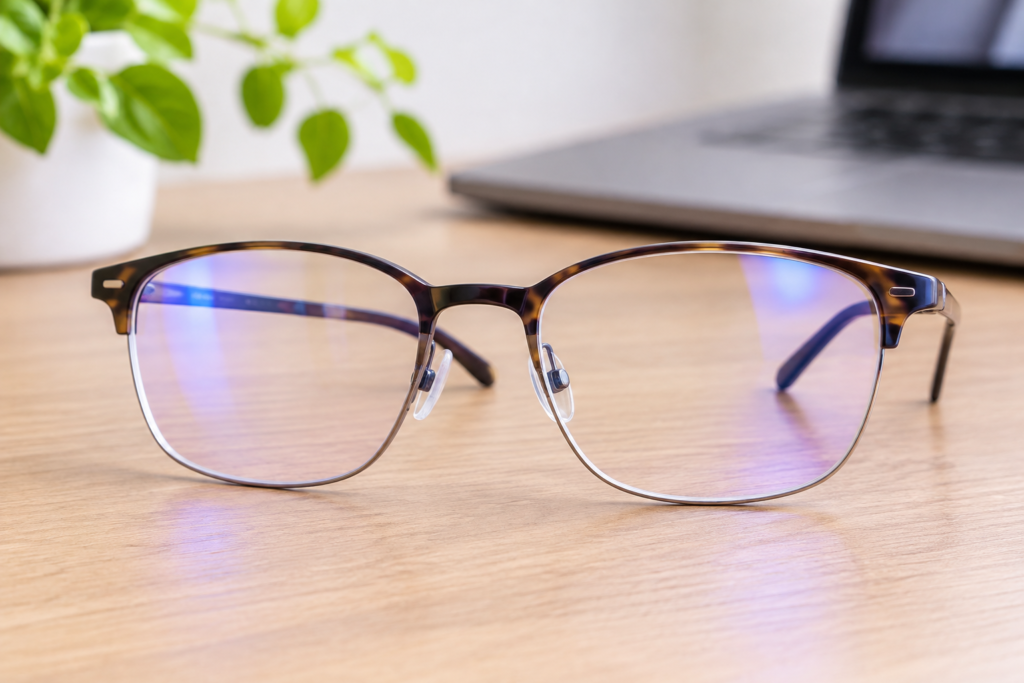
Ordering a new pair of glasses involves more than just choosing a good looking frame! Today’s lenses offer a variety of materials, coatings, and designs that can improve function and comfort. But with so many options available, how do you know which features are worth considering and what do they do?
- Start With an Accurate Prescription
With all the lens materials, coatings, and designs available in this day and age, it’s easy to get caught up in the latest features and upgrades. However, the foundation of great vision is an accurate prescription from your optometrist. Even the most advanced lenses cannot make up for an incorrect prescription. Your optometrist considers your vision, eye health, refraction, and daily activities to help determine which lens options are best for you.
- Choosing the Right Lens Material
Not all glasses lenses are made from the same material. Below are some of the commonly available materials:
Polycarbonate Lenses
Polycarbonate is lightweight, impact-resistant, and naturally blocks UV rays. It is especially popular for sports eyewear, for patients looking for durable lenses, and considered by many to be the “gold standard” for children’s glasses.
High-Index Lenses
If you have a stronger prescription, your glasses may be too thick or heavy with standard material. High-index lenses are designed to be thinner and lighter than most.
Standard Plastic Lenses
More traditional plastic lenses (also called CR39) remain a popular and affordable option, particularly for patients with lower prescriptions. This material is unfortunately not suitable for drill mounted lenses in frames that require that and does not have UV protection built in, so an additional UV-filter would be highly recommended.
- Understanding Lens Coatings and Enhancements
Anti-Reflective Coating (AR)
One of the most popular upgrades, anti-reflective coating reduces glare and reflections on your lenses. Benefits include: Less glare from headlights when driving at night, clearer-looking lenses when someone looks at you or takes a picture of you, and fewer distracting reflections when using digital devices.
Blue Light Filtering Lenses
These lenses are designed to reduce some of the blue light emitted by digital screens. They are popular among people who spend long hours on computers, tablets, and smartphones.
Photochromic Lenses (e.g. Transitions)
Photochromic lenses darken when exposed to UV light and become clear again indoors. Transitions is one of the best-known brands in this category. They are convenient for people who frequently move between indoor and outdoor environments.
- Choosing the Right Lens Design
The design of your lenses determines how you see at different distances. Your age, prescription, and daily activities help determine which option is best.
Single Vision Lenses
These lenses have one prescription throughout the lens. They are commonly used for distance vision, reading, or computer work but might not be best for more than one of those at the same time.
Bifocal Lenses
Bifocals contain two prescription areas. The upper portion is generally used for distance vision, while a smaller section at the bottom helps with reading. These lenses have a traditional visible line separating the two areas.
Progressive Lenses
Progressive lenses provide distance, intermediate, and near vision correction in one lens without a visible dividing line. Often called “no-line bifocals,” they are popular among patients who need help seeing at multiple distances. Premium designs offer improvements intended to maximize comfort and provide a smoother adaptation process.
The Bottom Line
The best pair of glasses for you isn’t necessarily the best for someone else. The ideal pair gives you clear, comfortable vision and fits your lifestyle. Before ordering your next pair, speak with your optometrist or optician about which lens materials, coatings, and designs are right for you. A little guidance can go a long way toward getting the most out of your new glasses!