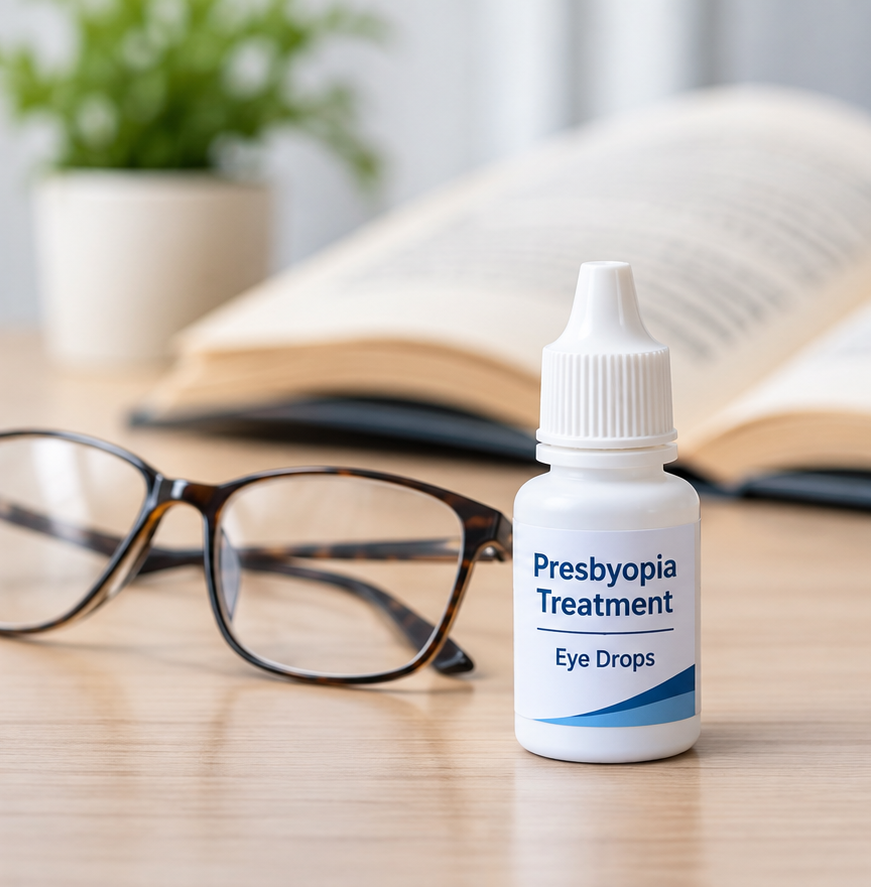
If you find yourself holding your phone farther away to read a text message or struggling to read restaurant menus, you may have presbyopia. This common age-related condition occurs around your early 40’s when the eye’s natural lens becomes less flexible, making it harder to focus on objects near to you. There is good news to share! Prescription eye drops offer another option for improving near vision without relying entirely on reading glasses. Read below about 5 eye drops that have FDA approval for this very issue.
- Vuity (Pilocarpine hydrochloride, 1.25%)
Dosing: One drop in each eye daily; an additional dose may be used after 3-6 hours.
Approximate cost: $90/month
Pros: First FDA-approved presbyopia drop; may improve near vision within 15-30 minutes.
Cons: May cause headaches, redness of the eyes, and temporary dim vision, particularly at night. Caution must be taken for patients at higher risk of retinal detachment. - Qlosi (Pilocarpine hydrochloride, 0.4%)
Dosing: One drop in each eye; repeat after 2-3 hours if needed, up to twice daily.
Approximate cost: $80-$100/month.
Pros: Lower pilocarpine concentration; preservative-free; flexible dosing.
Cons: May cause eye discomfort/pain, headaches and temporary blurred vision. Caution must be taken for patients at higher risk of retinal detachment. - Vizz (Aceclidine, 1.44%)
Dosing: One drop in each eye, followed by a second drop 2 minutes later, once daily.
Approximate cost: $79/month.
Pros: May provide improved near vision for up to 10 hours; preservative-free; primarily targets the pupil.
Cons: Redness after instillation, temporary dim vision, and headaches are possible. - Yuvezzi (Carbachol/brimonidine tartrate, 2.75%/0.1%)
Dosing: One drop in each eye once daily.
Approximate cost: $79/month.
Pros: Combines two medications; may provide up to 10 hours of improved near vision; preservative-free.
Cons: May cause eye irritation, headaches, and blurred vision. Caution must be taken for patients at higher risk of retinal detachment. - Ryzumvi (Phentolamine, 0.75%)
Dosing: One drop in each eye once daily at night.
Approximate cost: Received FDA approval October 2026 so presbyopia-specific pricing not yet known.
Pros: Uses a different mechanism by relaxing the iris dilator muscle; offers an alternative to traditional pupil-constricting drops.
Cons: May cause eye redness and irritation; commercial availability for its new presbyopia indication may be limited.
It is important to know that these medications temporarily improve near vision by changing how light enters the eye. They do not reverse aging or cure presbyopia. Some patients may still need reading glasses, especially in dim lighting or for prolonged reading. All of these medications require a prescription and an eye examination. Although quite rare, retinal tears or detachments have been reported with some of these treatments. Please discuss your eye health, retinal history, and individual needs with your eye doctor before starting treatment.
Here is the bottom line: Presbyopia treatment is evolving, giving patients more options than ever. Not all options are best for all patients but our optometrists can help determine which treatment best fits your lifestyle and visual needs.